...could end up withnothing for anybodyif a fi scal crisisderails growth
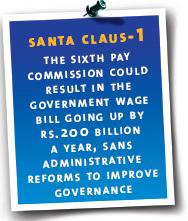
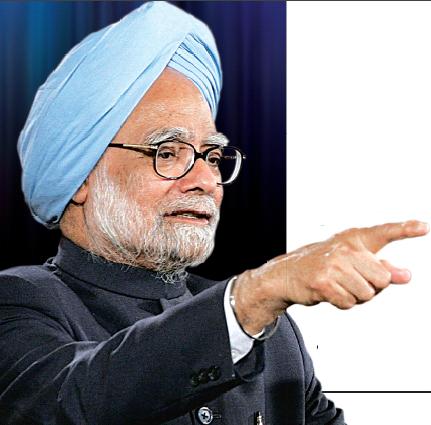
Money may not be able to buy love. But the UPA government appears convinced t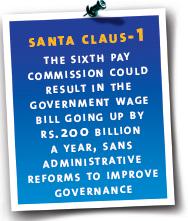 hat it can buy enough votes to propel the precariously perched present regime into a second term at the Centre. A few days after the bomb blasts in Mumbai shook the nation, the Union Cabinet announced the formation of a Sixth Pay Commission for central government employees. This will inevitably lead to a hike in salaries; and analysts estimate that the wage bill of the government could go up by as much as Rs.200 billion every year. But of course, this is one rare decision of the government that the omnipresent Left has welcomed with open arms. Says Atul Kumar Anjan, Politburo member of CPI, “We welcome the 6th Pay Commission report. It is a long pending demand of workers and employees.” When asked to comment on the reaction of businessmen and industry bodies like the CII and FICCI that this move could trigger inflationary pressures, Anjan is contemptuously dismissive. “It’s their practice to oppose any benefit to wage workers or government employees.
The Left parties are hopeful that inflation will be under control,” he adds. If vain hopes and misguided socialism were enough, India would have eliminated poverty, illiteracy and unemployment by now; farmers would not be committing suicide by the hundreds and many states of India would not report infant mortality rates worse than those in Sub-Saharan Africa. And now, analysts are worried that the current government is displaying alarming signs of going back to the bad old days of a peculiar mixture of misguided socialism and crony capitalism. In fact, the Sixth Pay Commission is just another example of how the UPA government appears determined to wear the robes of Santa Claus and dole out goodies, freebies and subsidies as if there were no tomorrow. Simultaneously, the government seems to be veering towards the bad old days of paternalistic and somewhat authoritarian ways, where the rulers were simply not held accountable by the public for their decisions and still had the powers to decide what is good and bad for Indian citizens. This is not just a display of bad democracy, it is also terrible economics.
For Complete IIPM - Article, Click on IIPM-Editorial Link
Source:- IIPM-Business and Economy, Editor:- Prof. Arindam Chaudhuri - 2006
 Here’s yet another red-blooded, driven entrepreneur, who has much more to his credit than just a legendary surname! A mechanical engineer from Pune University and Masters in manufacturing systems engineering from the University of Warwick in 1991, Rajeev Bajaj joined Bajaj Auto first as an officer on special duty and streamlined the manufacturing systems to improve the production quality and profitability. Since then, this bold Bajaj has concentrated on completely refurbishing the image of Bajaj Auto from old and ugly scooters to stylish and sleek two-wheelers! His role in this successful transition is applause-worthy, thanks to the manner in which he conceived and executed a realistic and result-oriented plan that focused on a few significant issues and delivered results! Rajeev is now steering Bajaj Auto towards the future with twin engine (petrol and LPG/CNG) two wheelers! That’s youth power for you!

 g his legendary kindness as a person, he will now be distinguished for all time by an act of aggression. Indeed, Zidane’s status as an emblematic champion of the world’s most universal and popular sport does not fully explain why people have been so obsessed with him. His human qualities, as much as his amazing talent and technical feats on the field, counted equally in establishing his popular acclaim. Football has always been this way. For example, for the Argentineans, the diminutive Diego Maradona represented the revenge of the weak and the deprived. As a result, his countrymen excused his frequent bad behaviour time and again. Similarly, Pelé became the symbol of a harmonious, inter-racial Brazil.